WASH
Ongoing

Carbon Credit Financing for Sustainable Rural Water Supply in Manyara Village
Abstract
Manyara Village faces structural constraints in accessing safe, reliable, and affordable water due to weak operation and maintenance (O&M) financing, inadequate governance structures, and low revenue recovery. Revenues gained from carbon trading will be used to cover O&M costs, expansion of water supply infrastructures and construction of new water schemes.
Introduction
Projects providing clean and safe drinking water for local populations in developing countries (for example, via construction or rehabilitation of boreholes) may be certified with Gold Standard or with other voluntary carbon standards for carbon credit generation.
The basic concept is that by providing clean drinking water the need for water purification via boiling is avoided and, in consequence, less firewood or charcoal is consumed. The achieved savings in combustion of non-renewable biomass can be further converted as reductions in tons of CO2e emissions and as verified emission reduction units (VERs). For the situations where some of the households currently do not boil water for purification purposes the principle of “suppressed demand” might be applicable and, in consequence, carbon credits claimed also for these situations.
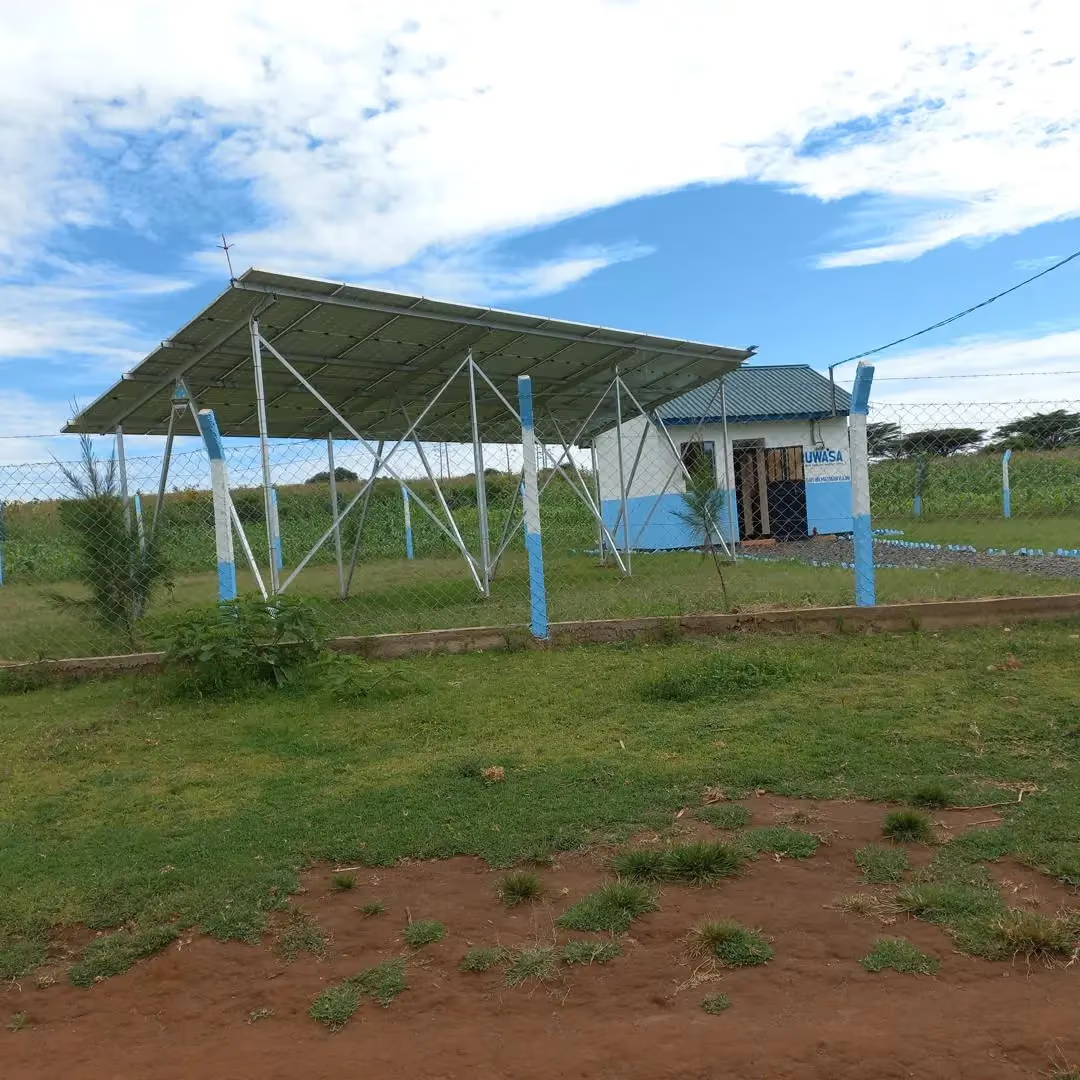
Also the project intervenes by retrofitting and replacing diesel generators and national grid power for pumping water in boreholes with solar systems which are environmentally friendly, less costful in operational and maintenance while ensuring service reliability and financial sustainability of water schemes.
The project utilizes carbon trading mechanisms to ensure the long-term functionality and financial sustainability of rural water schemes in Manyara Region - Tanzania
Key Activities
- Baseline surveys and end-user census
- Census of the current water sources available within the project target area,
- Census of the households living within the target project area to define the number of potential end-users within a 2.5 km range from the new water access points
- Baseline Survey on end-user characteristics and their water and fuel usage patterns
- Installation of solar-powered water schemes by retrofitting and replacing diesel generators and national grid power with clean energy to minimize carbon emissions and operation and maintenance costs to ensure reliable water supply and projects sustainability
- Annual Monitoring Activities
- Continuous monitoring of the functionality of water schemes (measurement of flow meters) which is done monthly in each water scheme by keeping records of water produced in bulk meters installed in each water scheme.
- Annual water quality testing at each water access point to ensure consistency with the national water quality standard requirements and a random water samples at household level to ensure that the consumed water is microbiologically safe, annually
- Biennial field measurement on daily water consumption (water consumption field test) to measure the average daily water consumption per household. Test is made over 4 consecutive days visiting households, at least 30 random households to be tested biennially
- Annual Awareness raising events via hygiene campaign events on water, sanitation and health issues is done a randomly selected water schemes
.avif)
Funded by
Carbon Sink Group
Lead organization
Istituto Oikos
Partners
Oikos East Africa
Time frame
2022 - 2032 (10 yrs)
More programmes


Empowering communities through sustainable conservation
We believe the health and wellness of future generations will be secured with today’s people-centered approach to environmental conservation.
.jpg)